
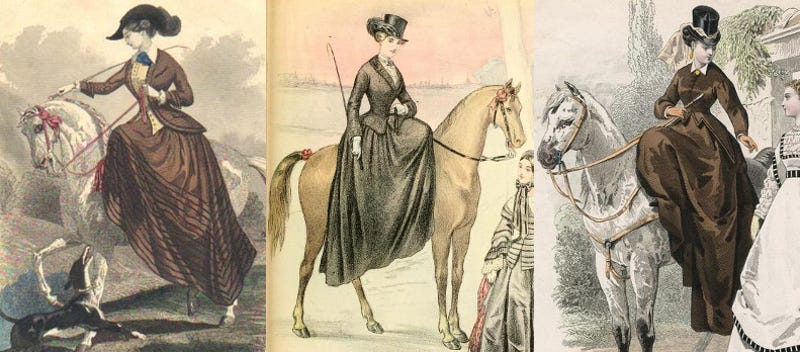
In 1864, horse shows appeared in Victorian England and Ireland to widespread interest. The combination of athletic prowess exhibited by both rider and mount, beautiful horses for sale or breeding, and equestrian attire on display proved to be an irresistible attraction. The main events were racing, driving, and the introduction of show jumping to great fanfare.
“Horse Show Week” became an entire event, including shopping, dining, and entertainment. It was also one of the first arenas where people from different economic classes participated together.
https://jvc.oup.com/2020/06/18/victorian-horse-shows/
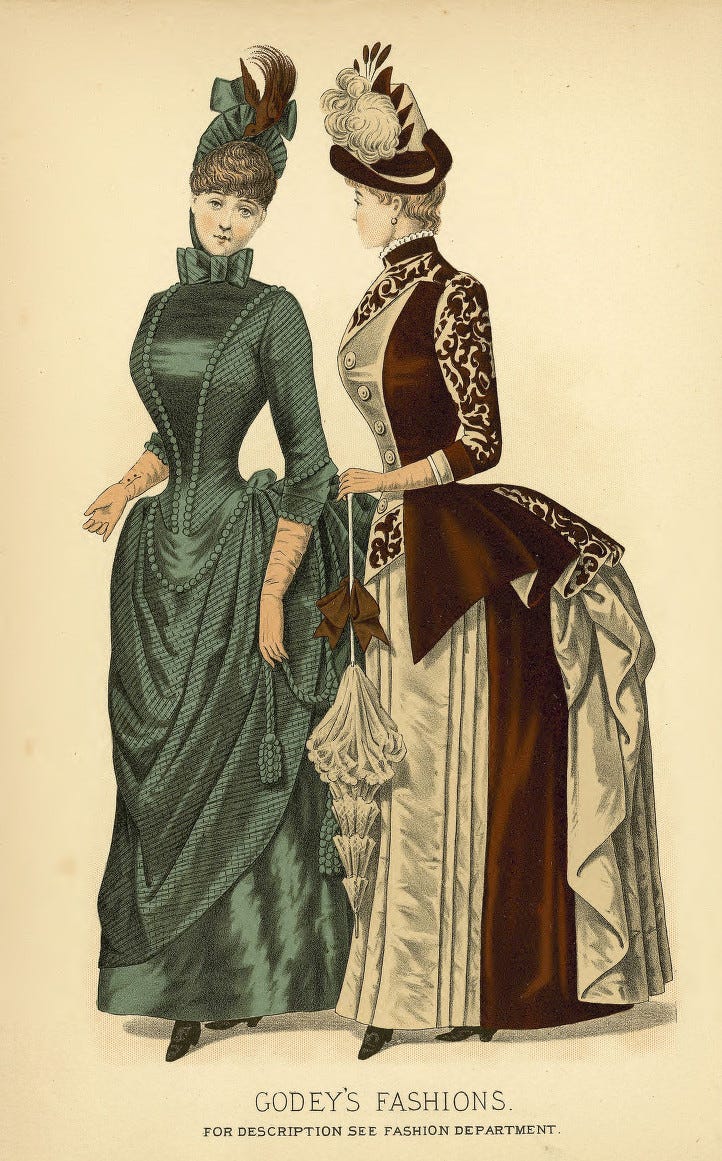
In 1883, Horse Show Week came to America. Taking place in Madison Square Garden at the end of October, this attraction proved to be more of a spectator sport rather than a community event. Showcasing the finest horses and English riding skills, people were thrilled by demonstrations of elegance, horsemanship, and training.
https://www.lib.uiowa.edu/gallery/exhibit-media/womens-riding-c-1900-horse-show-week-in-new-york-city/
People from all walks of life turned out in their finest attire to watch the competitions. As a result, clothiers displayed their newest collections for prospective buyers, thus establishing a precursor to New York Fashion Week.
Out in the southwestern United States, equestrian competitions developed in a very different way. Centuries earlier, charreada events were created in Mexico as way for rancheros to keep track of their cattle by rounding them up and branding them. By the turn of the century, local fairs and rodeo events were just taking root.
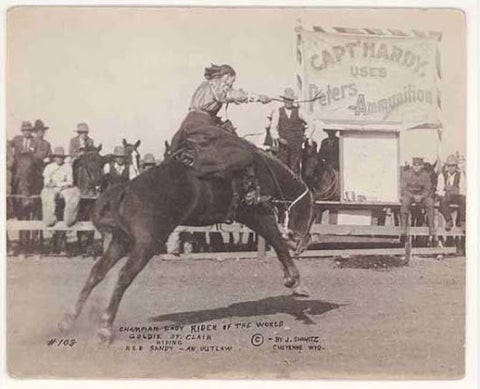
Here in New Mexico, the first was the Territorial Fair of 1881 (we wouldn’t become a state until 1912). Like the horse shows of Victorian England, they began as a way of showcasing livestock for sale and breeding before transitioning into something more entertainment focused. The main events were breaking, roping, and reining. More rough-and-tumble than elegant and sophisticated.
So how to compile all of this into a fictional horse show event that my main character would compete in, in an alternate 1890s New Mexico? I’ll let you know as soon as I figure it out!
Wish me luck,
Avery